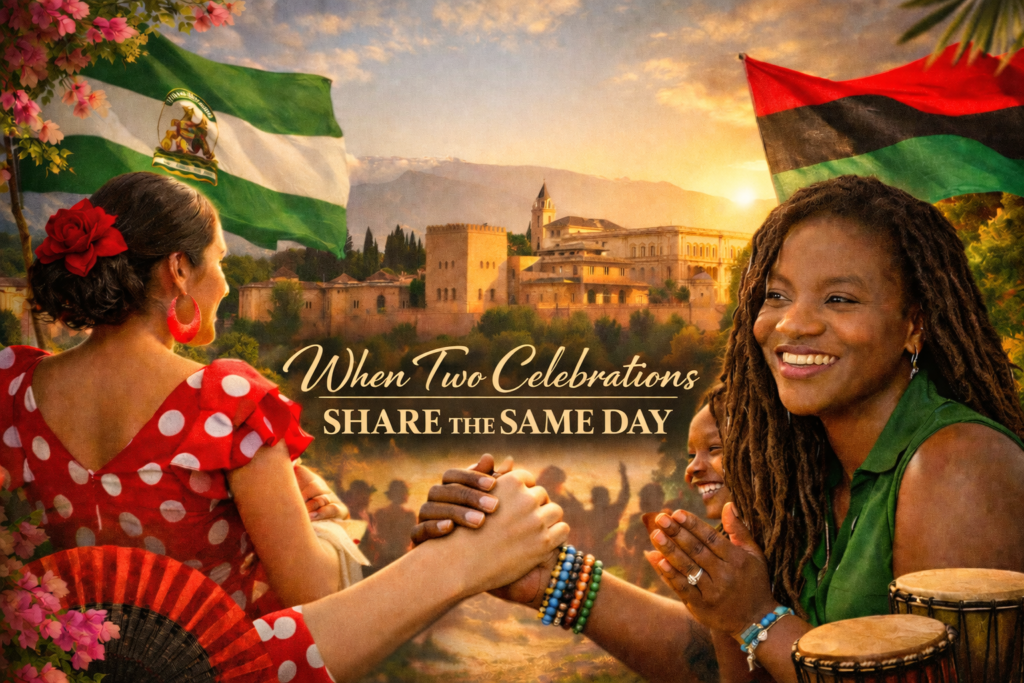
Every February, I find myself reflecting on Black History Monthand what it means, how it’s evolved for me, and how it shows up in our lives here in southern Spain. Black History Month is observed each February as a time to reflect on Black history, culture, and legacy: past, present, and still unfolding. This year, that reflection feels especially layered.
Our Black History Month celebration happens to fall on February 28th, the Day of Andalusia. It wasn’t planned that way. It simply aligned. And in that alignment, something quietly beautiful revealed itself.
For Andalusians, February 28th is a day of regional pride, of history, autonomy, culture, and belonging. For us, it marks the closing days of a month dedicated to honoring Black history, resilience, creativity, and joy. Two celebrations. Two timelines. One shared calendar space.
After eight years of living here, Andalusian culture is no longer something we observe from the outside. It’s woven into our children’s lives. I see it when they come home from school holding the green-and-white flag they colored themselves. I see it when they dress in traditional flamenco attire, moving comfortably between worlds that once felt so far apart.
As a Black American woman who arrived here as an adult, watching my children grow up bilingual, bicultural, and rooted in more than one place fills me with a quiet pride I struggle to put into words.
This year, that duality feels especially meaningful.
A close Spanish friend shared that every Day of Andalusia, she and her friends escape to the mountains, a ritual of familiarity and tradition. But this year, she told me she wanted to spend the day with us instead. “I love Black American gatherings,” she said. “The music, the joy, the pride. I want to be part of that.”
She wasn’t abandoning her culture. She was expanding her world.
It wasn’t about choosing one culture over another. It was about curiosity. About openness. About seeing a different world exist within her own homeland.
That, to me, is the beauty of coexistence.
Our celebration will include people from across the African diaspora: Black Americans, Africans, Caribbeans, and Spaniards who arrive not as spectators, but as participants. My hope is that someone looks around and realizes, I didn’t know this could exist here. A Black space. A joyful space. A communal space. In southern Spain. Sometimes, it just takes someone deciding to start, and to keep going.
Two celebrations. One day. Shared pride. Shared space.
And a reminder that culture doesn’t have to compete to coexist.